Saturday, June 2, 2012

Meta Post

My personal favorite post if the last quarter was "Fuel Efficiency: Is it Actually Improving?" Cars and alternate energy are both topics that I find very interesting, so I really enjoyed learning more about the history of cars fuel efficiency, as it is sort of a hybrid of both.

I believe that this post was one of my more coherent blog posts recently, but it is far from perfect. Looking back, I feel like I probably could have done a little bit more research in order to find more concrete facts that I would be able to include to further my argument/observations. I have also just realized that these issues are almost identical to those that I believed I was struggling with first semester. As the year has progressed I have also noticed that my favorite posts tend to be written about topics that I feel most strongly about. The one problem with this, is that I often end up focusing more on my opinions on the issues opposed to the factual evidence of the issues themselves. 

One other thing that I could change to improve the post, "Fuel Efficiency: Is it Actually Improving?", would be to bring in additional examples. I only discuss the Model T and the 2008 Ford Ranger. There is such diversity in the automobile industry nowadays, using one pick up truck does not really give people an accurate idea of modern cars. Trucks tend to be less fuel efficient than most cars, and now getting up to about forty miles per gallon in a sedan is fairly common. Apart from being somewhat limited in perspective, it is pretty good. 

While my blogs have become clearer as the year has progressed, they have also unfortunately been less and less frequent. Looking back at first semester posts, I had many simple proof reading mistakes and similar errors, but I was also blogging more regularly.

Thursday, May 24, 2012

Logos

I recently became aware of the "Logos Quiz Game" for Apple devices. After a little research I found out that I am not the only one that finds the whole idea of the game kind of strange. For any of you that do not know, the basic idea of the game is to try to correctly identify as many different brands logos as you can. The thing that surprises most, is how fun this simple activity can be. It is very interesting and almost addicting to see how many different logos you are able to remember.
As Anthony Wing Kosner of Forbes writes in an article, linked here, in this day and age people are surrounded by advertisements nearly everywhere they go. He also goes on to mention the potential that this App could have for helping businesses improve their advertising. If peoples results could be saved and analyzed, then companies might be able use them in order to improve their logo in order to make it more recognizable.
One other interesting things that I learned about the App was that the creator, Javier Perez Estarriaga, originally was creating the app for self enjoyment and a challenge. It pushes you to try to recognize the smallest letter or fragment. But we see these logos so frequently that they are almost burned into our brain, so now most people can recognize most logos almost subconsciously.

Sunday, May 20, 2012

America's Obsession with Teeth

I recently read a BBC News Magazine article (Linked Here), that both made me laugh, and really take a minute to think about American values. Ricky Gervais (creator of The Office) was interviewed by an American journalist a few years ago about his role as a dentist in a movie. The journalist then complimented Gervais for wearing bad fake teeth for the role. Gervais then said "He was horrified that I could have such horrible real teeth. It's like the biggest difference between the Brits and the Americans, they are obsessed with perfect teeth." 
I had never really considered the idea of years of orthodontic work to be strange at all. It is true that straight, clean, healthy teeth are actually beneficial to your health, Gervais though, is more surprised with the extreme measure that people in Hollywood take. Jimmy Steele. a, professor at the School of Dental Science at Newcastle University, has come to the conclusion that British people are more worried about teeth being functional and to some extent natural, while Americans would like their teeth to be functional, but also incredibly aesthetically pleasing. Hence all the obsession with whitening, I did not really now that teeth naturally tend to be more of a cream color than white. It is only by using a variety of chemicals that you can get a tooth to actually look white. 
The article also mentions that very much in contrast to Americans, most of the British public ridicules people for having drastic work done to their teeth. Living in America, I would be very happy to have a perfectly white and straight set of teeth, but it is always interesting to learn that everybody may not share our beliefs about somethings.

Monday, April 16, 2012

Fuel Efficiency: Is it Actually Improving?

While doing research for a paper about oil I came across some interesting facts about cars and their fuel mileage. In recent years due to the drastic increases in gas prices many people have been switching to FlexFuel cars. These cars run on a fuel called E-85 which is a mixture of 85% ethanol and 15% petroleum (Here is a link to an article about FlexFuel cars). 
People tend to think that FlexFuel is a recent technology but I was surprised to learn that that is not exactly true. The first FlexFuel car was actually a version of the Model T Ford made in 1908. In addition to that, I was equally surprised to learn that the original Model T actually achieved better fuel mileage than a 2008 Ford pick up truck. Henry Ford predicted the transition to alternate fuel sources a while ago. He said in an interview with the New York Times "The fuel of the future is going to come from fruit... There is fuel in every bit of vegetable matter that can be fermented." The idea of using corn and other produce as a means to fuel cars with clean burning alcohol is not a new one, but for some reason it has not become a popular way to power cars. Ethanol burns very clean and in doing so lessens the harmful emissions that are being released into the atmosphere.
Even though the Model T and a Ford pick up are not really comparable interns of size and weight I would have expected that with a hundred years of technological advances we could have made our cars a little bit more efficient. 


For more information see link

Sunday, April 8, 2012

Hybrids

Hybrids have become a big deal in the past few years as people have been working towards living more "green" lives. People have different motives for buying hybrid vehicles, but most wish to save the environment, gas money or both. Unfortunately for consumers, hybrids are not always as appealing as they seem.


Nick Bunkley of the New York Times recently wrote an article on hybrid cars and the pros and cons about them (Article link here). He wrote "Gas would have to approach $8 a gallon before many of the cars could be expected to pay off in the six years an average person owns a car."Most hybrids contain so much technology that the cost to make it, both a cost is money and to the environment, takes so long to prove beneficial that by that time most people would already have gotten a new car. The hybrids that do pay for themselves in an acceptable amount of time are the Toyota Prius and the Lincoln MKZ. 


Another aspect of new auto technology that people often do not think of relates to electric cars. Electric cars are powered by battery packs. While this does provide a very clean source of energy, it makes the cars much more expensive in addition to leaving them with a very limited range they can travel. Electric cars may be a big part of the future, but as of right now people are worried that they might not change that much at all. Electric cars are charged by simply plugging them in. What people are concerned about, is hoe this electricity is often coming from coal or oil burning power plants. Until America is able to change its sources of energy, having an electric car may not really have the results you would want.

Read more here: http://www.charlotteobserver.com/2012/04/08/3156923/hybrid-electric-car-owners-must.html#storylink=cpy

Monday, March 12, 2012

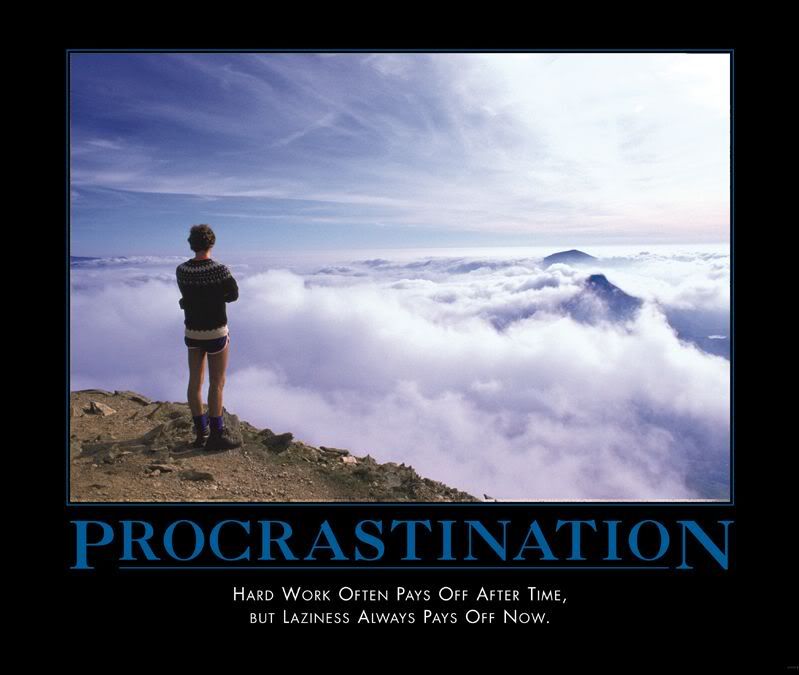
Procrastination, Good Thing?


To my luck, there are now people who say procrastination may be advantageous. Procrastinating on tasks may cause us to "experience a manageable amount of anxiety and stress, our brains produce dopamine that stimulates both innovation and higher performance on assigned tasks," this was said by Claire McLaughlin in her article, Procrastination Nation. Anxiety and stress may not be feelings I wish to experience, but it is nice to know that some of my finest work could come out of late night attempts to meet a deadline or complete an assignment.Procrastination

Procrastination is a problem that I face very often. It is normal for me to spend a Sunday night working on assignments that I have known about for days or even weeks. No matter how hard I try to push myself to get ahead, somehow I always seem to slip behind.


Recently NASA did some very complex research, and Dr. Ellen Weber who founded the Mita Brain Center simplified it to "while frustration or fear can flood the brain with cortisol, if anxiety is managed properly, anticipation can produce that feel-good dopamine that primes the pump of progress, or innovation." The general consensus among scientists seems to be that procrastinating, to some degree, can cause you to work harder and more efficiently. They also all agree that putting something off too long will only be detrimental. If you are forced into deprivation of sleep or last minute anxious scrambling then your work will be poor and your health may also be at risk.

Learning this has made me less judgmental of my late nights and last minute work, but if possible I still think working ahead would be the best course of action. I have felt the stress and anxiety caused by procrastinating all too often. Even with the benefits of high quality last minute work, being on top of all my assignments would be preferable.

Sunday, February 26, 2012

College Athletes

With March Madness coming up and all the hype over college basketball I have been hearing a lot about the idea of paying college athletes. Between college basketball and football, 6 billion dollars in revenue are produced (New York Times), but the athletes see none of it. Being a Division 1 athlete in college can take up as much as 50 hours a week, and that commitment leaves very little time for schooling. I found this disturbing because college is first and foremost for education.


With the commercialism of college athletes the students can sometimes lose sight of reality. Jerseys bearing their names, and their inclusion in very successful video games both help to inflate feeling of self importance in collegiate athletes, but the truth is very few of them have careers in sports. Basketball players only have about a 3% chance of going pro after they graduate. The athletes that have the best chance are baseball players, a whopping 10.5% end up in the MLB. 


I realize that college athletes getting paid may cause more issues, like bidding for potential students or uneven wages for athletes, but even with those potential issues I feel that paying student athletes would be a good thing. Because they cannot focus as much on their schooling, many athletes end up not being overly successful later in life. For the coaches, winning is everything. They do not particularly care if their athletes are struggling to find time for everything in their lives. Because of this, athletes, even though they often receive scholarships, often are left with large portions of their schooling to pay off.


I may not know all the details, but it seems to me that something must be done in college athletics. Whether it is paying their athletes or finding a different option, the current methods are not working as well as they should.

Tuesday, February 21, 2012

Starting Young

In recent years I have begun to notice that there is a strong correlation between starting a sport or activity at a very young age and being successful at it. I was again reminded of this last weekend as NBC was reporting on the up and coming stars in the USA hockey program. The kids that we are told to keep an eye on usually live a life that revolves around hockey.
 
If you search "How to be a good hockey player" in Google, the very first page, at least when I searched, was a WikiHow that emphasizes starting young above every thing else. It says, "The younger, the better. There's a definite pattern — the better hockey players are the ones that started earlier", and its true, most players that end up in the NHL began hockey between ages 3 and 6.


While it's true that this extreme commitment may make people better players, I'm not sure it's the best thing for all the kids that are involved. Once you are in high school there must be a balance between school and sports. The kids on Team USA u18 in Minnesota practice daily from 2 o'clock in the afternoon to late at night. Their lives become centered around hockey, but the sad thing is most people will not ever be able to make a career out of their sports passions. As Ken Campbell of ESPN says, you have "a better chance of winning the Powerball or 6-49 lotteries than [you do] of becoming an NHL player." Then more surprising, those people who succeed greatly on Junior or College teams have less than a 5 percent chance of becoming professional. 


I feel bad for a lot of the prospect athletes in the US who center their lives around a sport. Most give up a lot but end up not being rewarded for their efforts. In fact just by being born in America you chances are far lower than if you were born a few hours further north in Canada. I believe that sports are a great part of life, but it is wrong for parents, because it is due to them that their 4 year old is in a rigorous athletics program, to invest their kids lives in such an exclusive profession. Many people believe that they will be the one lucky person to get a spot on a team making millions each year, and a few will, but countless others will end up in more normal careers with their dreams left unachieved. 

Thursday, January 12, 2012

Blogging

Blogs are, as Dictionary.com says, "a Web site containing the writer's or group of writers' own experiences, observations, opinions, etc., and often having images and links to other Web sites." I have discovered that doing this can be a lot harder than expected.


I only started blogging earlier this year, and looking back I struggled to make powerful claims. In retrospect, my first couple posts all seem very similar. They are, for the most part, rants about topics that I felt passionately about at the time. I am not embarrassed by my early posts, but I do wish I could have made them better.


A major piece I was missing from those posts, such as Hockey More Show Than Sport, was concrete evidence. My arguments, such as the one about the role of "More enforcers" in hockey, could have been stronger if I found specific facts to discuss. Instead of doing this, I generalized almost everything. I wrote things like "he racked up countless penalty minutes"(from Hockey More Show Than Sport), in place of evidence. By summarizing and generalizing facts like that I weakened my argument. If I had used quotes like one from the Chicago Tribune where Chris Kuc, a reporter, said Carcillo "had 127 penalty minutes with the Flyers last season and is suspended for the first two games of 2011-12 because of an incident with an official during the postseason." This would have brought more authority to my argument because I would have reputable sources discussing hard evidence that relates to my topic. The lack of evidence was only one of many thing wrong with my blogs, but it is probably the one that I have tried the hardest  to remedy.


My more recent blog posts are far from perfect, but I believe there has been an improvement. My most recent blog post, Story Telling Through Music, uses direct evidence to further explain my points of discussion. In that post I took lines from the song "Ten Million Slaves" by Otis Taylor and connected them to our class discussions about slavery. I believe that my analysis for the lines in the song is pretty good, but there is still room for improvement. In that post I said, "The song parallels many of the horrible conditions slaves had to live through in the book A Narrative Life of Fredrick Douglass," and I followed that with an explanation of a line from the song. Looking back I do not understand why I did not also include a quote from A Narrative Life of Fredrick Douglass. The book has plenty of evidence in it that I could connect to a song about slavery, but for some reason I did not do it. The song has a set of lines, "Food goes bad, food looks Rancid / But they ate it anyway"that I quoted in my post. To connect to this, A Narrative Life of Fredrick Douglass has many lines that would work. One such line is on page 16 where it is said that "He that ate the fastest got the most; he that was the strongest secured the best place; and few left the trough satisfied." It would have helped my claim to connect those two quotes from different sources and discuss the necessity for food and how it was a challenge to eat enough to survive. But unfortunately I did not get to an analysis that detailed.


I am not disappointed with my blogging so far, but there is definitely room for improvement. My goal is to continue progressing and write a few blog posts that I am truly proud of, and that I feel effectively make the reader feel as passionately as I do about the topic being discussed.